Packaging delays rarely come from the filler alone. Washing queues, unsuitable returned jars, missing caps, sanitation holds and unreliable utilities can keep a line behind schedule even when its advertised speed looks adequate. By the end, you will be able to measure the real delay, compare manual and automated workflows, test a 20-litre line for fit and specify the site conditions required before installation.
Key takeaways
- Track every queue and stoppage before buying faster equipment.
- Compare usable output after washing, capping, changeovers and downtime.
- Test 20-litre returnable jars for fit, cleaning and hygienic handling.
- Confirm power, water, drainage, access and local service before installation.
Find the delay before choosing a faster machine
A jar filling machine for packaging delays in Nagpur will not fix a queue caused by missing caps, dirty returnable jars or slow dispatch. Watch one complete shift and record where each jar waits, how long each operation takes, and why the line stops.
Record these figures before comparing machines:
- Waiting time before washing and inspection
- Washing, filling and capping cycle time
- Minutes lost to cap shortages, water-level faults, overloads and emergency stops
- Number of rejected jars, including distorted necks and embedded dirt
- Cleaning, changeover, operator-break and dispatch-staging time
| Delay point | What to record | Evidence of the cause |
|---|---|---|
| Jar intake and inspection | Jars received per hour and rejection reasons | Supply, sorting or damaged-jar problem |
| Washing and rinsing | Cycle time and sanitation hold minutes | Washer capacity, detergent control or hygiene issue |
| Filling | Actual fill-cycle time and no-jar stops | Filler speed, sensor setting or water supply issue |
| Capping | Missing caps, cap-feed stops and rework | Cap quality, feeder or manual-placement problem |
| Finished-jar discharge | Time from sealing to vehicle loading | Conveyor, staging or dispatch bottleneck |
Run a site trial with your returned jars, caps and treated water. Clean demonstration jars can hide neck distortion and dirt that slow handling. Ask the supplier to demonstrate automatic stops for low water, no jar, missing cap and overload conditions; otherwise an apparent speed gain becomes underfilled-jar inspection and rework.
The largest measured delay, not the highest advertised speed, determines the machine you need.
What changes between manual, semi-automatic and automatic jar filling
A manual line leaves nearly every movement to workers: washing, inspecting, positioning, filling, capping, staging and loading for dispatch. Each handoff creates a queue, especially when returned jars arrive with dirt, damaged necks or inconsistent dimensions.
| Workflow | Labour-dependent steps | Where delays remain |
|---|---|---|
| Manual | Workers wash and inspect jars, place them under the filler, fill and cap them, move finished jars to staging, and load dispatch vehicles. | Every step depends on worker pace, including rejection and rework. |
| Semi-automatic | A machine performs filling or capping, but operators load jars, transfer them between stations, replenish caps, remove rejects and stack finished jars. | Transfers between separate machines and uneven loading create stoppages. |
| Automatic | A 3-in-1 or monoblock line transfers jars through washing, filling and capping with fewer handoffs. | Operators still remove heavily soiled or damaged jars, replenish caps, monitor detergent and rinses, clear sensor faults, and isolate product after a hygiene or filling failure. |
Automation reduces handling-related stoppages; it does not make dispatch labour-free. Staff still count, stage and load sealed jars, and they must respond when low water level, no jar, missing cap, overload or emergency-stop alarms halt the line.
For buyers comparing jar filling machine benefits in Nagpur, separate “automatic” from “unattended.” A site trial with returned jars, actual caps and treated water exposes cap misfeeds, crooked closures and slow manual rejection that clean demonstration jars hide. The best setup removes repeated transfers without removing the checks that protect fill volume and hygiene.
Measure usable throughput, not the jars-per-minute claim
A 600-jars-per-hour rating does not mean 4,800 saleable jars in an eight-hour shift. Calculate usable output with this formula:
Usable jars per day = rated speed × line availability × scheduled running fraction × product yield × planned hours
For example, an automatic jar filling machine in Nagpur rated at 600 jars per hour, with 85% availability, 80% scheduled running time and 98% accepted yield, produces about 400 usable jars per running hour. Across an eight-hour shift, that is roughly 3,200 saleable jars, not 4,800.
Use your own figures for each deduction:
- Availability: subtract mechanical faults, sensor stops, cap-feed interruptions and restart time.
- Scheduled running fraction: subtract breaks, cleaning, changeovers, sanitation holds and time waiting for jars, caps or treated water.
- Product yield: count filled and capped jars accepted for dispatch, excluding underfilled, leaking, damaged or contaminated jars.
Run the calculation against the order quantity and add the required dispatch buffer. A filler can have spare capacity while the washing section, draining stage or manual rejection point creates the real queue.
Ask for a trial using returned 20-litre jars, because distorted necks and embedded dirt can reduce yield faster than the brochure rating suggests. Also record how many operators are needed to replenish caps, clear faults and isolate product after a failed hygiene check.
Test a 20-litre returnable-jar line for fit and hygiene
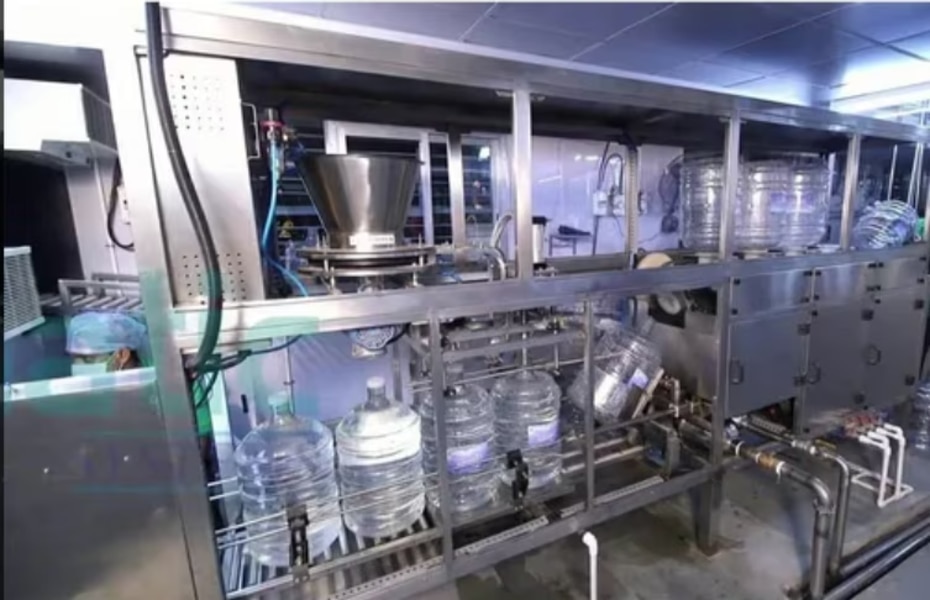
Twenty-litre returnable jars expose problems that new demonstration containers hide. Run the proposed water jar filling equipment in Nagpur with your own returned jars, caps and treated water, and time the complete route—not just the filler.
1. Check jar compatibility before the trial. Feed jars with distorted necks, inconsistent heights, embedded dirt and damaged rims. Confirm that guides, grippers, pockets and sensors reject unsafe jars without stopping the whole line; a narrow neck or unstable base can create repeated jams.
2. Watch every hygiene stage: empty-jar inspection, pre-rinse, internal and external detergent washing, clean-water rinsing, draining, treated-water filling, cap placement, sealing and finished-jar discharge. Record jars per hour at the washer, because a filler with spare capacity cannot recover a slow wash cycle.
Keep recovered water streams segregated; dirtier wash water must not become the final rinse without validated hygiene results.
3. Check handoffs and queues on the floor. A 3-in-1 or monoblock line keeps jars moving between washing, filling and capping, while separate machines need transfer tables, operators and buffer space. Mark space for rejected jars, cap storage, chemical handling, maintenance access and dispatch staging; a cramped outlet simply moves the queue downstream.
4. Repeat the trial with a realistic dirty-jar load and cap replenishment. Test sensor faults, manual rejection, sanitation holds and restart time. Operators still remove damaged jars, monitor detergent and rinse conditions, replenish caps and isolate product after a hygiene failure.
Approve the layout only when washing, filling, capping and dispatch sustain the same usable rate without unsafe queues.
Confirm Nagpur site utilities, service support and installation scope
Do not approve an automatic jar filling machine in nagpur from a brochure rating alone. Obtain a signed site document that matches the proposed line to your returned jars, caps, treated water and dispatch routine.
1. Confirm the electrical supply, phase, voltage, connected load, earthing, voltage protection and backup arrangement at the installation point. Ask for the compressor capacity, operating pressure, air quality requirement, dryer specification and receiver size; inadequate air or unstable voltage can stop sensors and pneumatic valves.
2. Require a trial using your dirtiest returned jars and actual caps. Record distorted necks, embedded dirt, inconsistent dimensions, cap-feed failures, rejection speed and the time needed to clear a fault.
3. Write the complete process scope into the quotation: empty-jar inspection, pre-rinse, detergent wash, clean-water rinse, treated-water filling, cap placement, sealing and finished-jar discharge. State whether a 3-in-1 or monoblock transfer is included, because manual movement between machines creates queues.
4. Fix commissioning responsibilities, operator training, hygiene validation, spare-parts availability, service response time in Nagpur, warranty exclusions and acceptance tests. Ask Orenus Water age technology to identify which items its team supplies and which your facility must provide.
5. Calculate usable output from rated speed × line availability × product yield × scheduled running time, deducting cleaning, changeovers, cap shortages, breaks, interventions and rejects. Confirm the same calculation for the proposed water jar filling equipment in nagpur before signing.
Related product
 | Mineral Water Plant Application Jar Filling Machine Type Automatic Filling Material Liquid Driven Type Electric Country of Origin Made in India Minimum order quantity: 5... View product → |
Frequently asked questions
How do you find the cause of water packaging delays before choosing a jar filling machine?
Watch one complete shift and record waiting time at jar washing, filling, capping, labelling, dispatch and every stoppage. Separate equipment speed from delays caused by missing caps, dirty jars, staffing or dispatch.
What changes between manual, semi-automatic and automatic jar filling?
Manual filling requires more operator handling and gives lower, less consistent output. Semi-automatic equipment reduces filling and handling work while keeping operators involved. Automatic lines coordinate rinsing, filling, capping and controls, but need suitable utilities, space, maintenance and trained staff.
How should you measure the throughput of a jar filling machine?
Measure accepted, capped and dispatch-ready jars per hour across a full shift. Subtract time lost to changeovers, cleaning, loading, cap shortages, rejected jars, breakdowns and other planned or unplanned stops instead of relying on the jars-per-minute claim.
What should you test on a 20-litre returnable-jar filling line?
Run your actual jars through rinsing, filling and capping. Check neck dimensions, jar stability, water contact surfaces, cleaning performance, leak-free seals, rejected containers and operator access before approving the line.
Which Nagpur site details must be confirmed before installation?
Confirm electrical supply, water quality and pressure, drainage, floor space, ventilation, access for delivery, storage for clean and dirty jars, and the installation boundary. Ask who provides commissioning, operator training, spare parts and service response in Nagpur.
Keywords