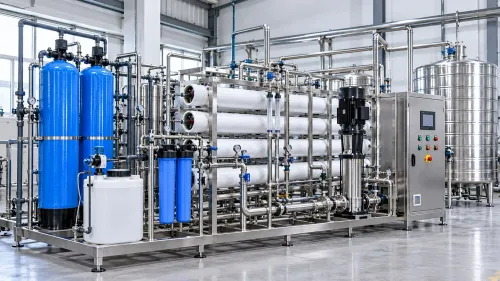
A semi-automatic stainless-steel RO plant can lose output, reject more water, or produce high-TDS permeate because of pretreatment, instrumentation, valves, pumps, membranes, or operator sequencing—not only because the membrane has failed. You will be able to build a maintenance schedule, log the readings that prove performance, distinguish operator resets from engineering repairs, and prepare a useful service brief for a Nagpur technician.
Key takeaways
- Confirm tank level, cartridge condition, valve position, and pump priming before startup.
- Calculate recovery as permeate flow divided by feed flow, multiplied by 100.
- Replace cartridges when pressure drop rises or the element is visibly fouled.
- Use lockout procedures before repairing pumps, electrical controls, or pressurised lines.
How semi-automatic RO operation works at the plant
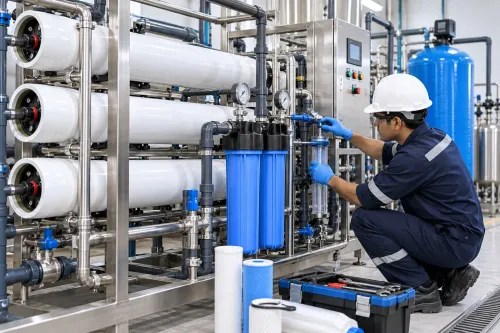
Open the feed-water valve only after confirming the raw-water tank level, cartridge filter condition, and pump priming. A semi-automatic skid then depends on the operator to place the correct valves in sequence; a wrong concentrate or permeate position can send untreated water to the product tank.
| Stage | Valve and control action | Readings and protection |
|---|---|---|
| Start-up | Open feed and reject valves, keep product on drain, then start the feed and high-pressure pumps | Check tank level, feed pressure, cartridge differential pressure, low-pressure cut-out, dry-run protection, and pump noise |
| Production | Set the concentrate valve for the specified reject flow; divert permeate to product only after quality stabilises | Record feed conductivity, permeate conductivity, pH, temperature, feed and concentrate pressure, and both flow rates |
| Flushing | Open the flush valve, reduce pressure, and route permeate and reject to drain according to the timer sequence | Confirm the automatic timer, high-pressure cut-out, valve travel, and unrestricted drain flow |
| Shutdown | Stop the high-pressure pump, close feed, release pressure, and leave the skid in its specified standby condition | Verify tank float switches, control interlocks, and zero pressure before service |
For a semi automatic ss ro plant for maintenance in nagpur, verify valve tags, flow arrows, pressure-switch settings, solenoid operation, and the operator’s actual sequence. Never bypass a high-pressure, low-pressure, level, or dry-run protection to keep production running. Record every reading with time and temperature; pump pressure alone cannot prove membrane performance.
The maintenance schedule and inspection checklist
1. Daily, record feed pressure, concentrate pressure, permeate and reject flow, feed and permeate conductivity, temperature, and cartridge-filter differential pressure. Check feed and high-pressure pumps for noise, vibration, seal leakage, and overheating; inspect gauges, flow meters, valves, switches, pipe joints, and the stainless-steel frame for leaks or loose fasteners.
2. Weekly, inspect the electrical panel for moisture, heat marks, loose terminals, damaged insulation, and tripped overloads. Test control switches, pressure switches, float switches, and solenoid-valve operation; confirm each valve reaches its full open or closed position without water hammer.
3. Monthly, compare pressure gauges against a reliable reference and verify conductivity meters with an appropriate standard. Inspect flow-meter tubes, floats, cables, and probes; clean or replace faulty sensors. Examine cartridge housings, pump couplings, threaded joints, clamps, gaskets, low points, and pump seals.
4. Quarterly, review ss ro plant maintenance records and compare normalized permeate flow and normalized salt passage using the same correction method for temperature, feed pressure, conductivity, and recovery. Verify both flow meters before changing recovery, and inspect weld discoloration, pitting, crevice corrosion, chloride residue, and galvanic contact with dissimilar metals.
5. Annually, isolate and service both pumps, test motor insulation and protective devices, tighten panel connections, and calibrate or replace pressure, conductivity, level, and flow instruments. Pressure-test pipework, overhaul worn valves and seals, inspect the frame beneath clamps and gaskets, and document every defect and corrective action.
The readings and formulas that prove RO performance
A plant that produces its rated litres per hour can still be rejecting salt poorly. Log each reading at the same operating stage, after stable flow begins, and record the date, time, feed-water source, and operator.
- Feed pressure and concentrate pressure, in bar
- Feed conductivity or TDS and permeate conductivity or TDS
- Feed flow, permeate flow, and reject flow, in LPH
- Water temperature and pH
- Cartridge-filter differential pressure: inlet pressure minus outlet pressure
- Chemical readings, including antiscalant dose or residual chlorine where tested
Calculate recovery as permeate flow ÷ feed flow × 100. If concentrate recirculates, include that flow in the feed-flow calculation or the recovery figure will be false. Calculate salt rejection as (feed TDS − permeate TDS) ÷ feed TDS × 100; salt passage is permeate TDS ÷ feed TDS × 100.
Compare normalized permeate flow and normalized salt passage against the commissioning baseline using the same correction method for temperature, feed pressure, feed conductivity, and recovery. Raw flow on a cold day can look like membrane fouling.
Verify conductivity probes with a suitable standard, compare pressure gauges, and inspect flow meters. A drifting permeate probe can trigger needless cleaning; a blocked gauge can hide cartridge plugging or a concentrate-valve fault.
During ro plant recovery service, verify both flow meters before changing recovery, because excess recovery can deposit calcium carbonate, silica, sulphate, or metal oxides on membranes.
Cleaning, cartridges, pretreatment, and stainless-steel corrosion
Replace a 5-micron cartridge when its differential pressure reaches the filter manufacturer’s limit, permeate flow falls after other checks, or the cartridge is damaged, collapsed, or visibly fouled. A rising pressure drop points to suspended solids loading; replacing it without checking turbidity or silt-density index only repeats the failure.
Use these triggers to choose the next action:
- Clean RO membranes when temperature-corrected permeate flow declines, salt passage rises, or the pressure drop across the elements increases after cartridge and pretreatment checks.
- Test activated carbon by measuring chlorine at its outlet. Any chlorine breakthrough can damage polyamide membranes, so investigate exhausted carbon, channeling, incorrect flow, or a bypassed valve.
- Test softener performance with hardness at the softener outlet. Hardness leakage directs you to salt supply, regeneration frequency, brine suction, resin condition, or valve sequencing before you blame membrane scale.
- Investigate scale when hardness leakage, inadequate antiscalant dosing, high recovery, or increasing element pressure drop appears. Investigate fouling when turbidity, iron, organic matter, or cartridge loading is high.
- Sanitize product-water piping, tanks, housings, and dispensing lines after membrane or pipework work, extended shutdown, or a microbiological result. Use a chemical compatible with the membranes and stainless steel, then rinse and verify final water quality.
Inspect stainless steel at welds, low points, threaded joints, pump seals, clamps, and gaskets. Chlorides, stagnant water, chemical residue, weld discoloration, and contact with dissimilar metals cause pitting or crevice corrosion. A semi automatic ro plant service report should record chemical concentrations, findings, replaced cartridges, membrane identification, and final readings.
Fault diagnosis, safe repair, and choosing a Nagpur service visit
Do not replace membranes before checking the symptom path. For semi automatic water plant repair in nagpur, compare a current log with feed and product-water tests, including temperature, rather than trusting pump pressure alone.
| Symptom | Trace first | Safe corrective action |
|---|---|---|
| Low permeate flow | Cartridge differential pressure, feed pressure, temperature, valve position, pretreatment, then membrane fouling | Replace a blocked cartridge or clean membranes only after confirming the cause |
| High permeate TDS | Conductivity meters, O-ring leaks, membrane age, chlorine damage, hardness or antiscalant failure | Divert product water; correct pretreatment and test each membrane vessel |
| Unstable pressure or excessive reject | Air entry, pump suction, flow-control valve, blocked concentrate line and recovery calculation | Remove air and verify flow meters before changing recovery; scaling can follow an unjustified increase |
| Cavitation, noise or pump trips | Low tank level, blocked suction strainer, closed inlet valve, bearing condition, overload and dry-run protection | Isolate power, depressurise, and repair the cause before resetting the trip |
| Leaks or water hammer | Loose fittings, cracked tubing, rapid solenoid closure and missing supports | Lock out the plant, replace seals or damaged pipe, and open valves slowly |
| Control fault | Float switches, pressure cut-outs, timer logic, interlocks and valve tags | Test each input and output; do not bypass protection |
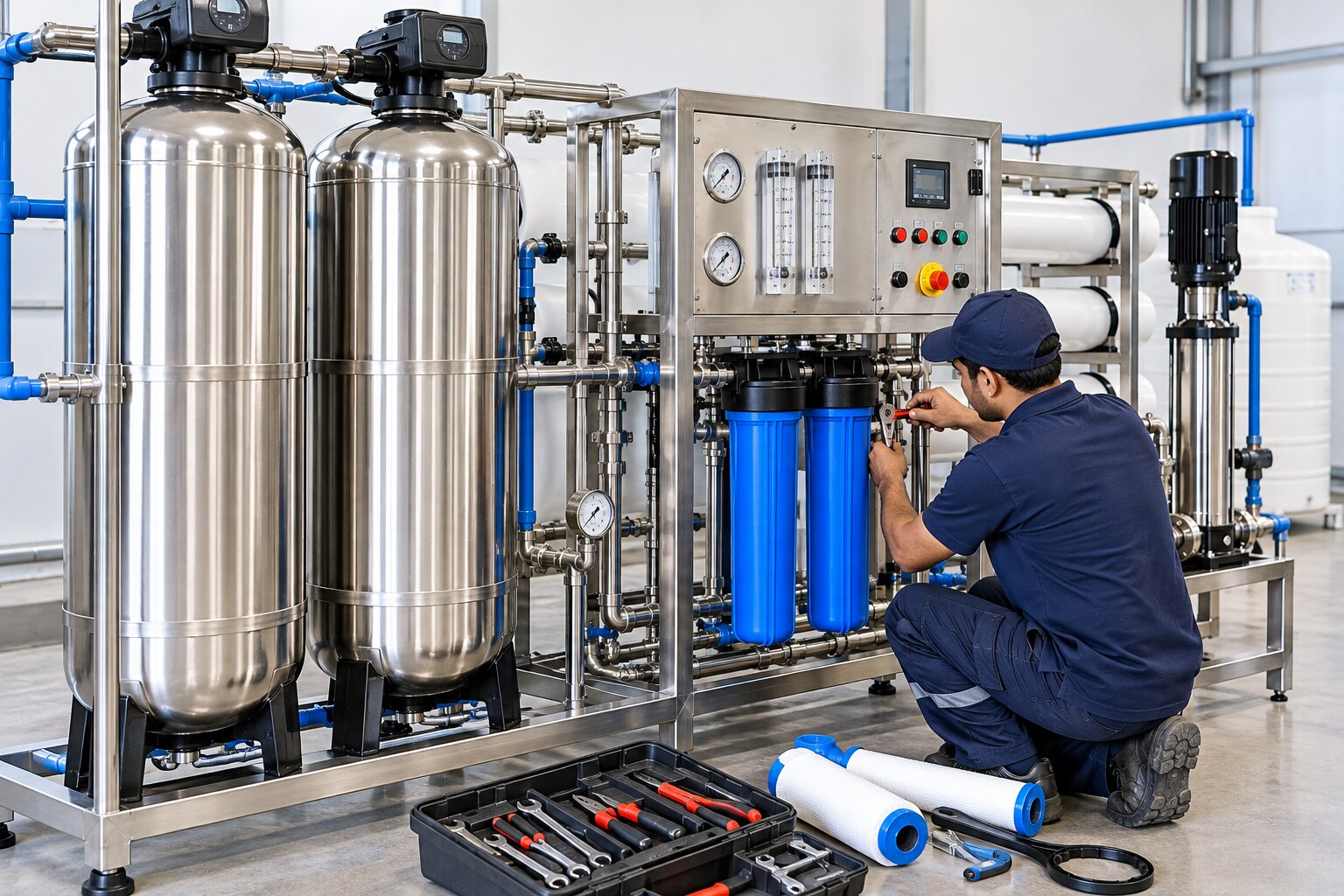
A service visit should include lockout, electrical testing, pressure release, and verification of the operator’s actual sequence. Ask Orenus Water age technology, or any Nagpur provider, to document as-found readings, chemical concentrations, membrane element numbers, parts replaced, final flow, conductivity, pressures, recovery, and the follow-up date. “Serviced” proves nothing.
Related products
 | Mineral Water Plant Material Stainless Steel Working Pressure 100 PSI RO Capacity 3000 ltr/hr Deliver Type Pan India Installation Service Yes Country of Origin Made in... View product → |
 | RO Water Plant RO Capacity 500-1000 (Liter/hour) Material Stainless Steel Automation Grade Automatic Usage/Application Industrial Max Water Recovery Rate 65-70 %... View product → |
Frequently asked questions
How does a semi-automatic RO plant operate?
An operator manually places the feed, concentrate, permeate, flushing, and drain valves in sequence while the pump and controls run the treatment cycle. Verify each position before sending water to the product tank.
How do you calculate RO plant recovery?
Use recovery percentage = permeate flow ÷ feed flow × 100. Measure both flows during stable operation and record the readings with feed pressure and water temperature.
What readings indicate declining RO performance?
Compare feed pressure, concentrate pressure, permeate flow, permeate TDS, feed TDS, and cartridge pressure drop with the plant’s clean baseline. Falling permeate flow or rising permeate TDS points to fouling, scaling, leakage, or membrane damage.
When should an RO cartridge filter be replaced?
Replace the cartridge when differential pressure increases beyond the equipment maker’s limit, flow falls after pretreatment checks, or the element is visibly blocked or damaged. Record the replacement date and cartridge specification.
What safety steps are required before semi-automatic RO plant repair?
Stop the pump, isolate electrical power, close and lock water valves, release trapped pressure, and confirm zero pressure on the gauges before opening housings or piping. Use chemical-resistant gloves and eye protection during cleaning.
Related products
 | Mineral Water Plant RO Capacity(Litre/Hr) 1000 LPH Material FRP Automation Grade Semi Automatic RO Membrane Type Thin-Flim Composite (TFC) Media Activated Carbon + sand... View product → |
 | Mineral Water Plant Capacity 200 BPM Power Consumption 2 hp Bottle Type plastic Usage/Application industrial Packaging machines are used to package products or... View product → |
Keywords