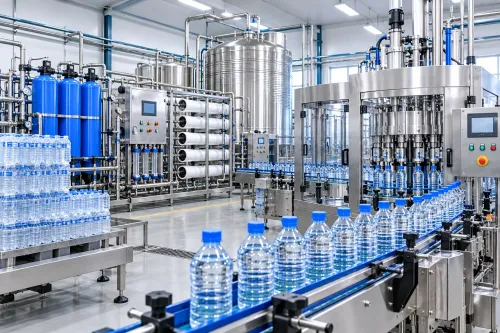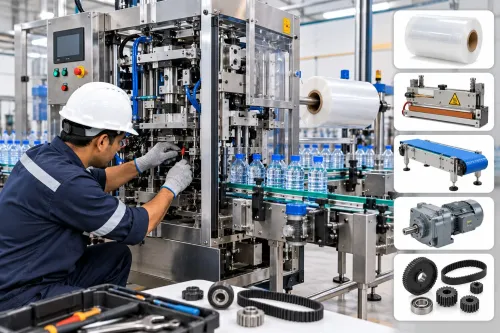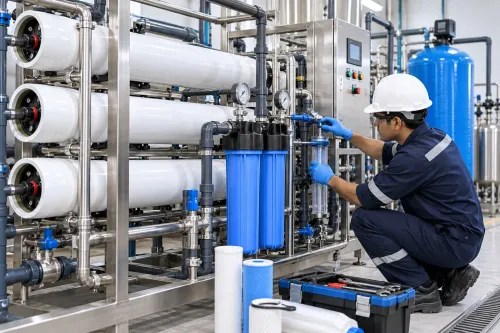
A bottling plant can keep producing clear water while its membranes, filler valves, cap chute or compressed-air system quietly increases contamination risk. A disciplined Nagpur maintenance programme combines seasonal source-water checks, equipment records, hygienic release procedures and fault diagnosis before changing settings or replacing expensive parts.
Key takeaways
- Record water quality, settings and calibration dates before handover.
- Trend RO pressure, conductivity, recovery and reject flow each shift.
- Release equipment only after documented cleaning, sanitisation and test results.
- Choose service partners with defined repair, hygiene and release procedures.
Set the maintenance baseline before the first failure
Record the baseline before commissioning handover: source-water quality, treatment settings, equipment condition, hygienic-zone layout and every instrument’s calibration date. A mineral water bottling plant for maintenance in nagpur must be managed as two linked systems: water treatment and hygienic filling/packaging.
Treated water can meet its process targets while filler valves, cap chutes, dead legs, storage tanks or conveyors recontaminate it.
1. Create an equipment register covering the borewell pump, sand and activated-carbon filters, cartridge housings, RO skid, UV unit, ozone generator, tanks, transfer pumps, rinser, filler, capper, labeller, compressor, chiller and electrical panel. Assign each item an identification number, service interval, spare-parts list and responsible person.
2. Establish daily, weekly, monthly, quarterly and annual tasks. Record pressure, flow, conductivity or TDS, recovery, chlorine residual, UV intensity, ozone, filter differential pressure, fill volume, cap torque, leaks and downtime. Trend source-water pH, turbidity, hardness, iron and microbial results through monsoon and summer.
3. Put IS 14543 or IS 13428, the applicable FSSAI licence conditions and the current testing scheme in a controlled-document register. Do not rely on an old certificate or supplier brochure.
4. Approve a shutdown and restart procedure covering drainage, cleaning, sanitisation, stagnant-water disposal, filter release or replacement, flushing, microbiological sampling and documented approval before saleable production resumes. Include ventilation, panel cooling, compressor drains and power-protection checks before Nagpur’s hottest period.
Use measurements to find RO and utility problems early
A drifting sensor can make you change dosing or RO recovery for a problem that does not exist. Cross-check online pH, conductivity, turbidity, flow, pressure and ozone readings against calibrated portable instruments before adjusting the process.
| Measurement | Warning sign | Required response |
|---|---|---|
| Online pH, conductivity or turbidity | Differs from the portable reading | Calibrate, repair or replace the sensor; record the result |
| Filter differential pressure | Rises above the clean baseline | Backwash or replace the sand, carbon or cartridge filter |
| RO flow and salt rejection | Normalised permeate flow falls 10% below baseline, or rejection declines | Check temperature, cartridge filters, antiscalant, pump pressure and meter calibration before cleaning or replacing membranes |
| UV intensity or ozone output | Falls below the equipment alarm or validated release limit | Clean the sleeve or service the generator; replace the lamp or ozone components when output stays low |
| Pump pressure, vibration or seal condition | Pressure drops, vibration increases or water reaches the seal | Repair the pump, seal or bearing before it damages the RO system |
| Compressor pressure and electrical voltage | Pressure cycles abnormally or voltage fluctuates | Repair leaks, drains or regulators; inspect protection and connections |
Track feed conductivity, TDS, hardness, iron, alkalinity, turbidity and microbial results across summer and monsoon periods. A source-water shift can overload pretreatment even when the production recipe is unchanged.
Mineral water plant repair in Nagpur should end with calibration, a sanitation release and a documented verification result. Do not replace RO membranes by age alone. Record the affected batch or production window.
Clean, sanitise and release the water-contact system correctly
A treated-water result does not release the filling line. Manage treatment and hygienic filling as separate controls: tanks, transfer lines, filler valves, rinser, cap chute, capper, conveyors and packaging-contact surfaces need their own sanitation and release records.
Before production or after any product-contact repair:
- Drain stagnant water, remove debris and dismantle accessible valves, hoses, nozzles, drip trays and dead-leg sections.
- Clean with a validated chemical and record its name, concentration, temperature, contact time and equipment compatibility.
- Sanitise the tank, product line and filler path, then rinse until the approved chemical endpoint is reached.
- Verify filler valves, seals, springs and hoses are intact; keep lubricant, compressed air condensate and cleaning chemicals away from product-contact areas.
- Release the line only after visual inspection, required water-quality checks and documented approval.
Check ozone at the injection point and, where used, near the treated-water tank or filler. A generator-output reading alone does not prove disinfection: inspect the injector, venturi, contact tank, off-gas destructor, tubing and residual-ozone instrument.
Store bottles, caps and other packaging sealed, dry, covered and above the floor. Reject crushed, dusty or wet packs, and sanitise caps or bottles only through a validated process. After an extended stoppage, drain stagnant water, replace or release filters, flush the system, complete microbiological sampling and approve the first saleable batch in writing.
Diagnose filling-line faults without creating a hygiene risk
Stop the filler, place affected bottles on hold, and protect open product from dust, tools and hands. Confirm fill volume, pressure, flow, pH, conductivity and ozone with calibrated portable instruments before changing settings; a drifting sensor can turn an instrument fault into a treatment fault.
Clean and sanitise any product-contact part opened during diagnosis, then document the release decision.
Check these fault signatures:
- Underfilling: compare nozzle flow, filling pressure, valve timing and bottle position; inspect a clogged nozzle or low product level before changing the recipe.
- Foaming: check water temperature, pump suction leaks, excessive turbulence, dissolved air and ozone dose; never correct foam by extending contact with an uncleaned filler.
- Cap leaks: measure cap torque, inspect caps and neck finishes, and check the capper chuck, liner and sealing height.
- Jams: stop the conveyor before reaching into it, isolate power and air, then inspect guides, star wheels, sensors, belts and fallen caps.
- Label defects: check bottle dryness, adhesive temperature, roll alignment, sensor calibration and conveyor speed.
- Compressed-air faults: drain condensate, check dryer status, filter differential pressure, oil carryover and receiver hygiene. Wet or oily air can contaminate cap handling and product-contact equipment.
After repair, flush or sanitise affected lines, reject stagnant water, verify the first bottles, and record downtime and corrective action. Choose mineral water bottling plant service in Nagpur that supplies this hygiene-focused restart record, not only mechanical repair.
Choose a Nagpur maintenance partner by its release and repair process
Choose a bottling plant maintenance company in Nagpur that gives you a controlled release process, not only a technician and spare parts. The contractor must manage the treatment system separately from the hygienic filling area, because compliant RO water can still be contaminated by filler valves, cap chutes, tanks, dead legs or conveyors.
| Service need | Evidence the contractor must provide | Release decision |
|---|---|---|
| Planned service | Work order, calibrated-instrument readings, source-water trend review, chemical-cleaning record and replaced-part traceability | Supervisor approves operation against the plant’s baseline |
| Emergency repair | Fault diagnosis separating sensor error from process failure, temporary controls, corrective action and a sanitation check | Do not release product until readings and contact surfaces pass review |
| Extended shutdown | Drainage plan, stagnant-water disposal, tank and line cleaning, sanitisation, filter assessment or replacement, flushing, microbiological samples and signed approval | Resume saleable production only after documented water-quality and hygiene release |
For mineral water plant repair in Nagpur, require technicians to cross-check pH, conductivity, flow, pressure, ozone and turbidity against calibrated portable instruments before changing dosing, RO recovery or reject settings. Ask for chemical name, concentration, temperature, contact time, rinse endpoint and post-cleaning criteria.
The contractor’s controlled-document register should identify the applicable IS 14543 or IS 13428 edition, amendments and current FSSAI testing scheme. Ask Orenus Water age technology, or any shortlisted provider, to show a sample service report before work begins; vague “machine checked” entries are not a release record.
Related products
 | Mineral Water Plant Filling Capacity 30 Bottle/min Type Of Machines Fully Automatic Laboratory Chemical Laboratory Customization Yes Driven Type Electric Voltage 380V... View product → |
 | Mineral Water Plant Filling Capacity 100 bottle/min Water Purification Process RO Automation Grade Automatic Water Filling Method Bottle Installation/Civil Work... View product → |
Frequently asked questions
What maintenance baseline should you record before production starts?
Record source-water quality, treatment settings, equipment condition, hygienic-zone layout and each instrument’s calibration date before commissioning handover.
Which measurements reveal RO and utility problems early?
Track inlet and outlet pressure, permeate conductivity, recovery, reject flow, pump condition, tank levels and utility readings against the commissioning baseline.
How should you release a water-contact system after cleaning and sanitisation?
Follow the approved cleaning and sanitisation procedure, verify chemical concentration and contact time, rinse where required, inspect the system and document test results before release.
How do you choose a mineral water bottling plant service partner in Nagpur?
Ask for its preventive-maintenance schedule, fault-response process, spare-parts plan, sanitation controls, repair records and documented production-release procedure.
Related products
 | Mineral Water Plant Packaged Drinking Water Bottle Plant Filling Capacity 10 Bottle/min Water Purification Process RO Automation Grade Semi-Automatic Country of Origin Made in India Container Type Pouch For... View product → |
 | Mineral Water Plant Capacity 200 BPM Power Consumption 2 hp Bottle Type plastic Usage/Application industrial Packaging machines are used to package products or... View product → |
 | RO Water Plant RO Capacity 500-1000 (Liter/hour) Material Stainless Steel Automation Grade Automatic Usage/Application Industrial Max Water Recovery Rate 65-70 %... View product → |
 | Mineral Water Plant RO Capacity(Litre/Hr) 1000 LPH Material FRP Automation Grade Semi Automatic RO Membrane Type Thin-Flim Composite (TFC) Media Activated Carbon + sand... View product → |
Keywords