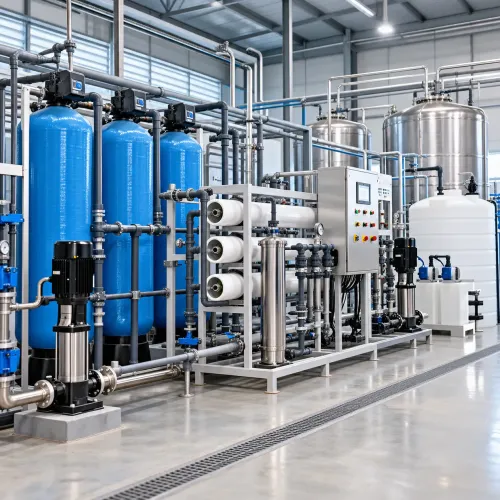
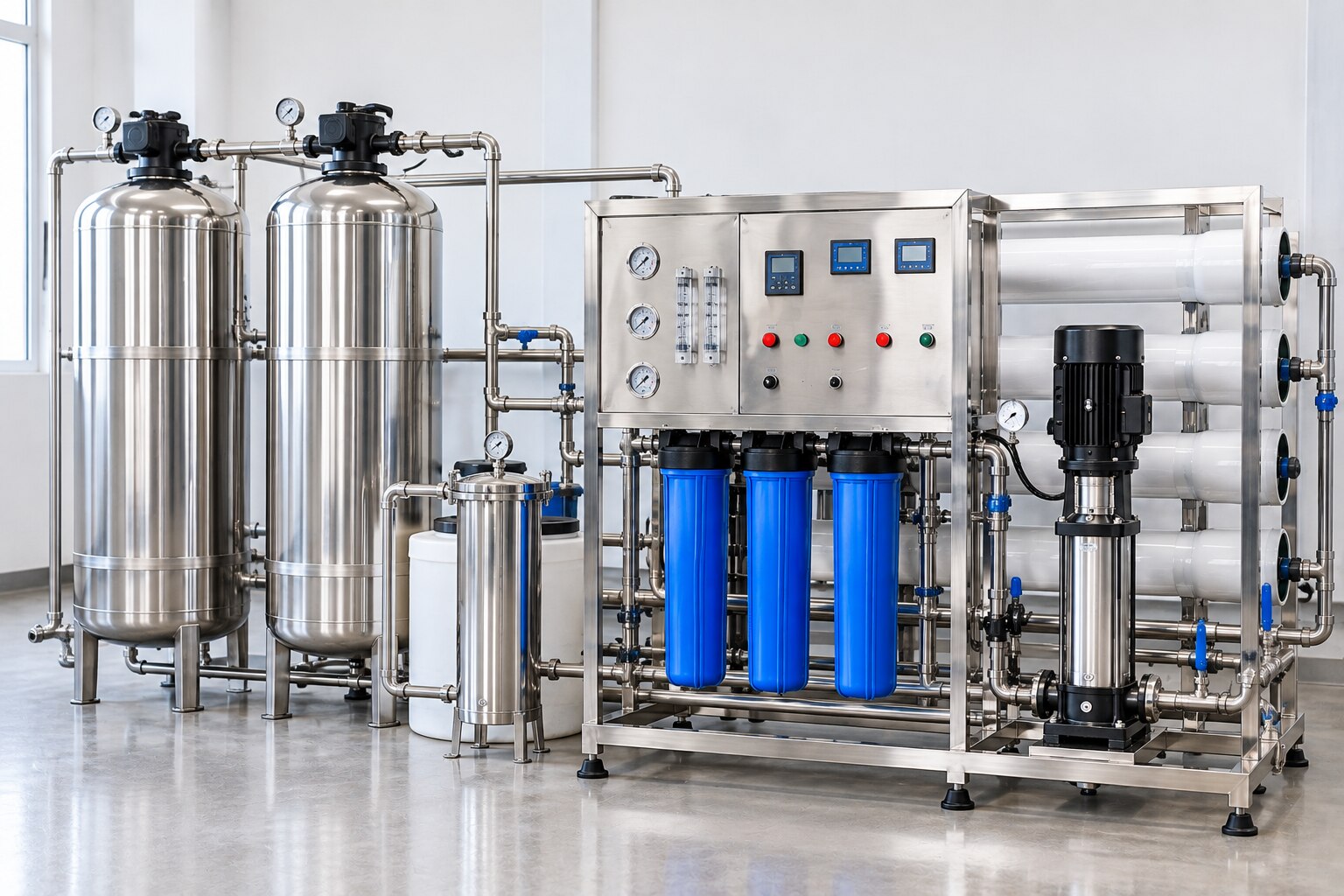
A 3,000-litre-per-hour label does not tell you how much saleable water you will produce, how much feed water you will consume, or how much time an operator must spend on valves, flushing, cleaning, and tank transfer. By the end, you will be able to match plant capacity to your shift, assess Nagpur source-water risks, compare stainless-steel specifications, and request a quotation that defines performance rather than relying on catalogue wording.
Key takeaways
- Assign an operator for pump controls, valve changes, flushing, dosing, and conductivity checks.
- Size output from your shift hours, filling rate, cleaning time, and storage capacity.
- Test raw Nagpur water before selecting filters, antiscalant dosing, or membrane capacity.
- Compare quotations using stainless-steel grades, operating costs, and documented acceptance results.
What semi-automatic operation requires from your operator
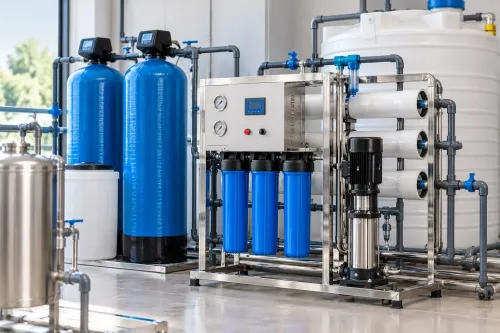
A semi automatic ro plant in nagpur still needs an operator at the controls. The operator may start the feed and high-pressure pumps, change filter-valve positions, check pressure and conductivity, open the flushing line, add chemicals, transfer permeate to the product tank, and stop production when the tank is full.
Miss a valve change and the plant can lose recovery, foul its membrane, or send off-specification water to storage.
Ask for a written I/O list before accepting the quotation. It must identify each automatic protection and each manual action.
- Low-level and high-level cut-outs
- Feed-pump dry-run protection
- High-pressure trip
- Automatic membrane flushing
- Antiscalant dosing
- Alarm indication
- Tank transfer and shutdown sequence
Use the quotation language this way:
| Label in quotation | What it may mean | What you must obtain |
|---|---|---|
| Semi-automatic | Operator starts, monitors, or changes selected functions | A step-by-step operating sequence |
| Automatic | Only specified functions run without intervention | The exact automatic functions and alarm responses |
| Both terms | Conflicting or incomplete description | One signed I/O list defining every manual and automatic action |
Do not resolve the contradiction by accepting the more favourable label. Require commissioning demonstrations for pump protection, flushing, dosing, tank-level stops, alarms, and emergency shutdown. Also compare operator hours, feed-water requirement, connected load, reject-water volume, cartridge use, cleaning chemicals, and membrane replacement assumptions; those items determine the plant’s real operating cost.
Size the plant from your shift and filling demand
A 3,000 LPH RO rating means 3,000 litres of permeate per hour at stated feed temperature, pressure, recovery and water chemistry—not 3,000 litres in every shift. Theoretical production is 18,000 litres in six hours or 24,000 litres in eight hours.
Subtract startup, flushing, filter backwash, tank changeover, cleaning and filling delays; seven productive hours yields 21,000 litres before further losses.
| Product | Is 3,000 LPH suitable? | Main constraint |
|---|---|---|
| 20-litre jars | Yes, for about 150 jars per hour at the rated flow | Jar washing and filling speed |
| Pouches | Yes, if the pouch machine matches the water supply | Continuous storage buffer |
| Bottles | Yes for small or moderate filling lines | A fast filler can exhaust the RO tank |
| Bulk water | Yes, and usually the simplest match | Delivery demand and tank capacity |
Size storage from the gap between RO production and filling demand. A filling line that runs during RO cleaning needs a finished-water tank large enough to cover that interruption; a line that operates only after purification can use a smaller tank but waits longer.
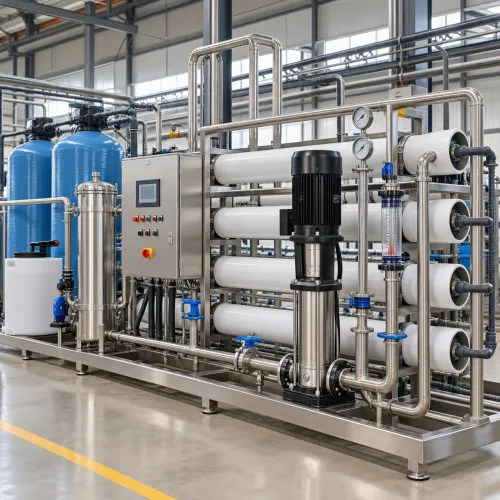
For a semi automatic stainless steel ro plant in nagpur, demand the feed-flow, permeate-flow and reject-flow figures. At 60% recovery, producing 3,000 LPH requires 5,000 LPH feed and creates 2,000 LPH reject. Higher recovery reduces reject volume but raises scaling risk.
The purchase specification should guarantee permeate flow and conductivity at test conditions. Record feed temperature, feed and reject pressure, permeate flow, recovery and permeate TDS at commissioning. That is the practical basis for sizing a small water plant in nagpur.
Test Nagpur water before choosing pretreatment
TDS alone cannot select pretreatment. Before specifying a small water plant in nagpur, send borewell or municipal samples to a laboratory and record pH, turbidity, hardness, alkalinity, chloride, sulphate, iron, manganese, silica, nitrate, fluoride and microbiological quality. Add arsenic and other regulated contaminants when the source or local risk warrants them.
Ask for these source-specific checks:
- Borewell: iron, manganese, hardness, silica, fluoride, nitrate, arsenic, and seasonal changes in water level and chemistry.
- Municipal supply: free residual chlorine, turbidity, microbiological quality, and changes after supply interruptions or line repairs.
- Monsoon: repeat turbidity and microbiological testing after heavy rain, because surface ingress can raise suspended solids and contamination even when TDS remains stable.
| Source | Main risk to control | Pretreatment to specify |
|---|---|---|
| Borewell | Hardness, iron, manganese, silica and scale | Sediment filter; iron-removal media; softener or antiscalant; cartridge filter |
| Municipal | Chlorine, variable turbidity and biological contamination | Sediment filter; activated-carbon dechlorination; cartridge filter |
| Any source after monsoon | Sudden turbidity and microbial loading | Upstream settling or coagulation where testing justifies it, followed by sediment filtration and disinfection |
Do not assign every problem to the RO membrane. Turbidity and iron foul it, hardness and alkalinity create scale, chlorine damages polyamide membranes, and microbial growth causes biofouling. Require feed-water test results, design limits, and a retest schedule in the quotation.
Check stainless-steel construction and hygienic water handling
A shiny skid does not prove hygienic construction. For a stainless steel RO plant in Nagpur, verify the metal, every wetted component, and the records produced at commissioning.
- Confirm whether product-contact parts use SS 304 or SS 316. SS 316 offers stronger resistance to chloride-containing water, but chloride concentration, pH, cleaning chemicals, temperature, stagnant water, welding quality, and passivation still determine corrosion risk.
- Ask for weld-finish and passivation details. Rough welds, internal crevices, dead legs, and trapped water can corrode or harbour contamination even when the quoted grade is suitable.
- Demand a wetted-material schedule, not simply “SS plant.” It should identify piping, membrane vessels, filter housings, valves, gaskets, pumps, and media. FRP, UPVC, PVC, polypropylene, and elastomers may be acceptable when selected for the water and chemical duty.
- Inspect the product tank specification: closed lid, sanitary inlet, screened or filtered vent, drainable bottom, minimal dead space, and hygienic outlet. Confirm the cleaning and sanitisation method, frequency, and chemical compatibility.
- Record feed TDS and temperature, feed and reject pressure, permeate flow, recovery, permeate conductivity or TDS, leakage, and alarm operation during acceptance. These readings separate membrane fouling from pump, valve, sensor, or raw-water problems later.
- If you sell sealed jars, bottles, or pouches, verify current FSSAI requirements, the applicable product standard such as IS 14543, licensing, laboratory testing, packaging, labelling, and inspection obligations before commissioning. Do not apply bulk-water rules to packaged water.
Compare the quotation by operating cost and acceptance data
A quotation for a semi automatic stainless steel ro plant in nagpur is incomplete if it gives only capacity and steel grade. Ask for the figures below on the same feed-water basis, including temperature and TDS.
| Item | Ask the supplier to state | Why it changes the decision |
|---|---|---|
| Feed utility | Feed-water flow, daily volume, pump duty, connected electrical load, and running kW | Low feed flow or a weak pump reduces production; high connected load raises operating cost |
| Consumables | Cartridge-filter size and replacement interval, antiscalant dose, membrane cleaning chemicals, and membrane replacement assumption | A cheap quotation becomes expensive when cartridges foul quickly or dosing is unspecified |
| Reject water | Feed, permeate, and reject flow; recovery percentage; drain, storage, or reuse arrangement | Higher recovery cuts reject volume but increases scaling risk; lower recovery needs more disposal capacity |
| Operator time | Valve changes, pump starts, flushing, chemical refilling, conductivity checks, tank transfer, and shutdown steps | Manual work creates labour cost and missed-flush failures |
| Instrumentation | Pressure gauges, flowmeters, conductivity or TDS meter, alarms, and level switches | Missing instruments make faults difficult to separate from raw-water change |
For a semi automatic ro plant in nagpur, obtain a written I/O list: confirm whether low- and high-level cut-outs, dry-run protection, high-pressure trip, auto-flush, dosing, and alarms work automatically. Orenus Water age technology should state these functions in the offer rather than relying on the word “automatic.”
Record commissioning readings and sign them with the supplier:
- Feed TDS and temperature
- Feed, reject, and permeate pressure
- Feed, permeate, and reject flow
- Recovery percentage
- Permeate conductivity or TDS
- Leakage, alarm, and shutdown operation
These baseline values expose later membrane fouling, pump failure, instrument error, or incorrect valve settings.
Related product
 | Mineral Water Plant Material Stainless Steel Working Pressure 100 PSI RO Capacity 3000 ltr/hr Deliver Type Pan India Installation Service Yes Country of Origin Made in... View product → |
Frequently asked questions
What does a semi-automatic RO plant operator need to do?
The operator starts and stops pumps, changes filter-valve positions, checks pressure and conductivity, flushes the system, adds chemicals, transfers permeate, and stops production when the product tank is full.
How should you size a small water plant in Nagpur?
Calculate required litres per shift from filling demand, operating hours, cleaning and flushing time, and available permeate storage. Do not size only from the pump or membrane rating.
What water tests should you complete before choosing RO pretreatment?
Test raw water for TDS, hardness, alkalinity, iron, manganese, turbidity, pH, chlorine, and microbiological quality. Use the results to select filtration, softening, dosing, and membrane protection.
What should you check in a stainless steel RO plant in Nagpur?
Check the stainless-steel grade, weld finish, pipe dead legs, drainability, product-water contact surfaces, hygienic tank fittings, instrument locations, and cleaning access.
Keywords