A quoted capacity such as 5,000 LPH is not enough to compare industrial RO plants: you also need the feed temperature, water analysis, recovery, membrane arrangement, pressure, permeate quality, and operating hours behind that number. Use the specification points below to test whether a quotation covers the treatment process, supplied equipment, reject handling, commissioning, and long-term operation.
Key takeaways
- Define LPH as permeate output, feed flow, or membrane rating.
- Match pretreatment to Nagpur feed-water test results, not plant capacity alone.
- Check membrane recovery, reject flow, array, and guaranteed permeate quality.
- Request a model-by-model list of equipment, site work, and operating essentials.
Define capacity, pressure, and guaranteed output before comparing models
A quoted 5,000 LPH is not a usable capacity figure until the quotation identifies what the flow measures. It must say whether LPH means permeate output, feed flow, or nominal membrane rating, and state the operating hours used to calculate daily production.
- Permeate flow in LPH and m³/day, operating hours per day, design feed temperature, minimum and maximum seasonal temperatures, recovery percentage, and required permeate conductivity or TDS.
- Feed-water analysis covering TDS, hardness, silica, iron, manganese, turbidity, silt density index, pH, temperature, and microbial condition.
- Operating pressure, high-pressure pump duty, power consumption, and the feed, permeate, and reject flow rates.
2. Require the membrane design, not merely the words “industrial membrane.” The industrial RO system specifications should name the membrane model, pressure-vessel count, elements per vessel, staging arrangement, design flux, feed pressure, recovery, and projected permeate flow.
3. Separate guaranteed values from estimates. The guarantee should tie permeate flow, recovery, conductivity or TDS, power, and pressure to a defined feed composition and temperature. Industrial RO plant specifications in Nagpur must account for temperature correction because membrane output changes with water temperature.
| Quotation wording | What it tells you |
|---|---|
| “5,000 LPH capacity” | Basis is unknown |
| “5,000 LPH permeate at 25°C” | Output and reference temperature are defined |
| “5,000 LPH permeate, 75% recovery, 20°C minimum” | Production, recovery, and seasonal design basis are comparable |
Match pretreatment to Nagpur feed-water chemistry
Start with a recent laboratory report covering dry-season and monsoon samples. An industrial water purification plant in Nagpur needs design limits for TDS, hardness, alkalinity, silica, nitrate, iron, manganese, turbidity, SDI15, pH, temperature, free chlorine, and microbial activity; a single LPH rating cannot replace those figures.
| Parameter | Limit to specify | Pretreatment decision |
|---|---|---|
| Turbidity and SDI15 | Turbidity below 1 NTU and SDI15 at or below 3, unless the membrane warranty states a tighter limit | Multimedia filtration, followed by a 5-micron cartridge filter |
| Hardness and alkalinity | Report calcium, magnesium, bicarbonate, and calculated scaling risk at the proposed recovery | Softener, antiscalant, or reduced recovery |
| Silica, TDS, and nitrate | State each concentration in mg/L and the required permeate limit | Antiscalant, pH adjustment, a lower recovery, or specialised treatment |
| Iron and manganese | Measure dissolved and total forms separately | Oxidation followed by iron-removal filtration |
| Free chlorine | Keep polyamide-membrane feed below the membrane maker’s stated maximum | Activated carbon or sodium bisulphite dosing |
| pH and temperature | Give minimum and maximum design values; show output corrected to 25°C | Chemical adjustment and temperature-based capacity correction |
| Microbial condition | Include bacterial load and biofouling history | Sanitation, upstream control, and UV where required |
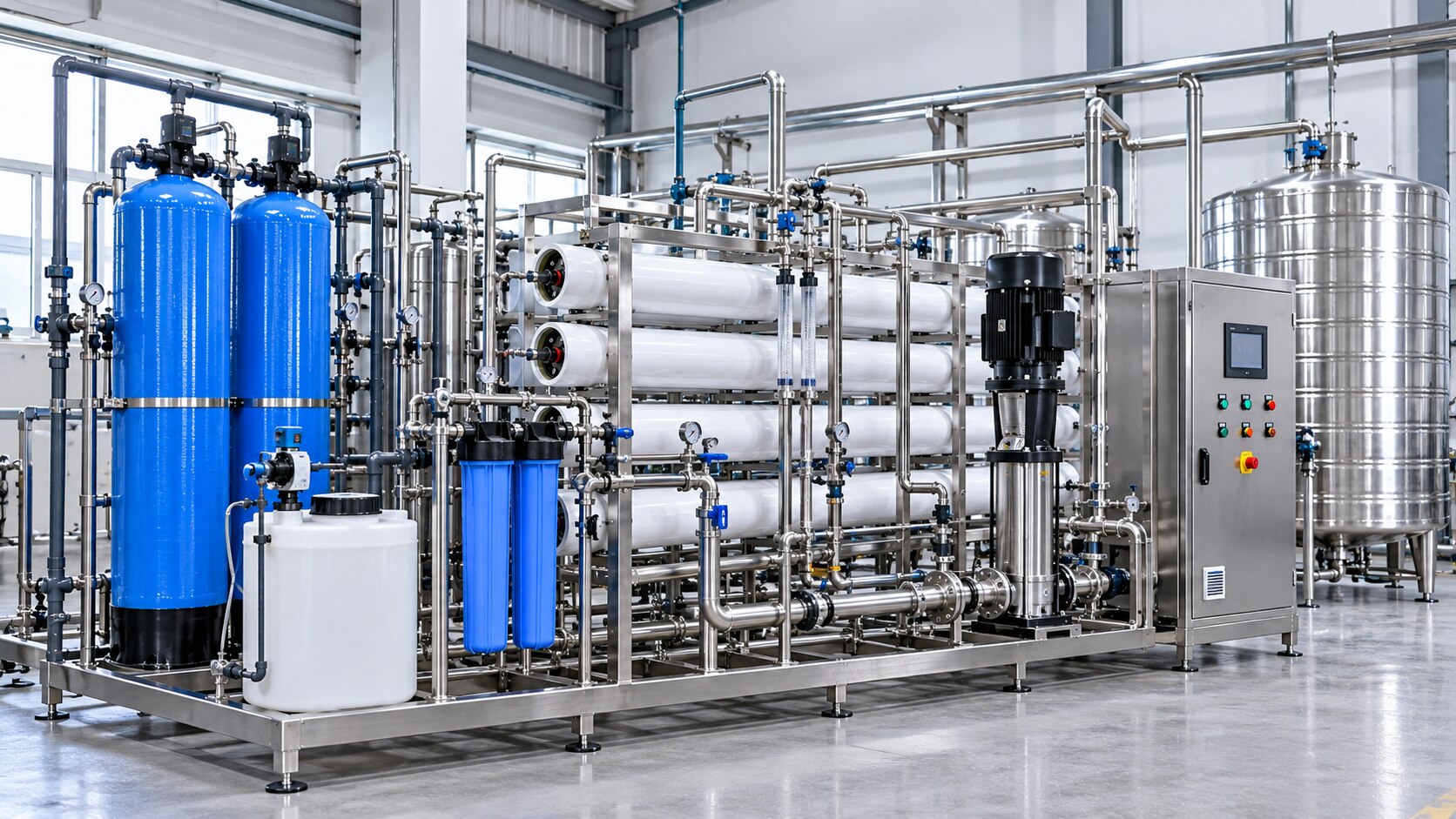
Multimedia media removes suspended matter; it does not fix dissolved hardness, silica, nitrate, salinity, or iron. Require the quotation to show the raw-water tank, feed pump, each pretreatment vessel, dosing point, cartridge rating, and the resulting RO inlet limits. Reject any proposal that guarantees production without seasonal temperature and feed-chemistry assumptions.
Check the membrane array, recovery, and reject-flow calculation
A quoted 5,000 LPH means little unless it identifies permeate output, operating hours, feed temperature, recovery, pressure, and feed-water analysis. Ask for industrial RO system specifications showing the membrane model, number and type of pressure vessels, elements per vessel, staging arrangement, design flux, feed pressure, and projected permeate flow.
Check these figures against your water report and required permeate quality:
- Match the membrane projection to feed TDS, hardness, silica, iron, manganese, pH, temperature, turbidity, SDI, and microbial condition.
- Require projected permeate conductivity or TDS at the stated feed composition and temperature, not a generic rejection percentage.
- Check calcium carbonate, sulfate, silica, barium, and strontium saturation at the proposed recovery; concentrated reject can scale the membranes.
- Confirm the membrane model’s operating limits and the cartridge-filter, antiscalant, softener, or other pretreatment assumed in the calculation.
- Separate guaranteed permeate flow, recovery, conductivity or TDS, pressure, and power consumption from indicative values.
Verify the flow arithmetic yourself. At 10 m³/day permeate and 80% recovery, feed flow must be 12.5 m³/day and reject flow 2.5 m³/day. Reject is feed minus permeate, not an unexplained percentage. Require reject flow in m³/day, its disposal or reuse route, and confirmation that the pump, piping, tank, and drain can handle it.
A higher recovery is not automatically better if scaling or permeate-quality limits force cleaning and downtime.
Separate included equipment from site work and operating essentials
Ask the quotation to identify every item included in the skid, every site responsibility, and every operating input. Otherwise, a low price can exclude the feed pump, tanks, cabling, or reject line.
Industrial RO plant specifications in Nagpur should show this split:
| Scope | Include or define | Confirm separately |
|---|---|---|
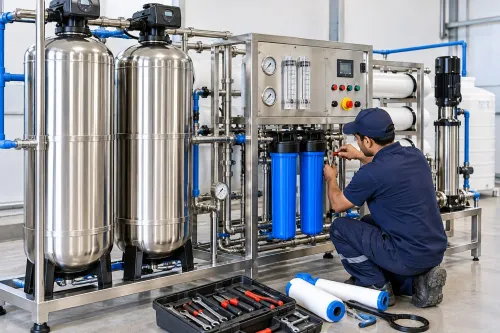
| Equipment | Raw-water and permeate tanks; multimedia, activated-carbon, iron-removal or softener vessels; cartridge filter; feed and high-pressure pumps; membrane vessels and elements | Tank material, volume, pump duty, membrane size and count |
| RO package | Permeate and reject piping, valves, chemical dosing, electrical panel, pressure switches, flow meters, conductivity or TDS meters | Connection sizes, termination points and reject-flow destination |
| CIP provision | Cleaning tank, CIP pump, cartridge filter or strainer, isolation and bypass valves, compatible hoses or fixed connections | Cleaning chemicals, storage, procedure and operator responsibility |
| Site work | Foundations, platforms, room drainage, raw-water and reject pipelines, electrical cabling, earthing and lifting | State whether civil, plumbing and electrical installation are included |
| Operating essentials | Antiscalant, filter media, cartridges, membranes, calibration, training and preventive-maintenance schedule | Consumption rates, replacement intervals and warranty limits |
For an industrial water purification plant in Nagpur, require raw-water and permeate test reports, pump and motor data, instrument calibration certificates, membrane serial numbers, operating set points and as-built drawings.
Also name the party responsible for groundwater permission, effluent consent, sampling and reject disposal. A CIP connection without a cleaning method is not a usable provision; specify triggers such as rising normalized pressure drop, falling permeate flow or rising salt passage.
Use a model-by-model schedule to select a Nagpur supplier
Reject any bid that gives one LPH figure for several models. Ask every industrial RO plant supplier in Nagpur to complete the same model-by-model schedule, using permeate flow at a stated feed temperature, not feed-water flow or nominal membrane capacity.
Model | Permeate flow | Pressure / recovery | Electrical load | Membranes | Feed / reject flow | Dimensions 500 L/h | Guaranteed at °C | bar / % | kW | vessels, elements, -inch | / L/h | 1,000 L/h | Guaranteed at °C | bar / % | kW | vessels, elements, -inch | / L/h | 3,000 L/h | Guaranteed at °C | bar / % | kW | vessels, elements, -inch | / L/h | 5,000 L/h | Guaranteed at °C | bar / % | kW | vessels, elements, -inch | / L/h |
Require separate guaranteed and indicative values for permeate conductivity or TDS, power consumption, operating pressure, recovery, and output across the stated minimum and maximum water temperatures. The supplier must identify the membrane model, pump type, feed-water limits, and temperature-corrected production.
Make commissioning a contractual deliverable. Obtain raw-water and permeate reports, calibration certificates, pump and motor data, membrane serial numbers, set points, as-built drawings, maintenance and consumables schedules, warranty boundaries, operator training records, and a responsibility matrix for approvals.
For potable use, assign responsibility in writing for hygienic storage, final disinfection, sampling points, and testing against IS 10500 or IS 14543. Orenus Water age technology belongs on your comparison sheet only after it supplies these same records and guarantees.
Related products
 | RO Water Plant RO Capacity 500-1000 (Liter/hour) Material Stainless Steel Automation Grade Automatic Usage/Application Industrial Max Water Recovery Rate 65-70 %... View product → |
 | RO Water Plant Capacity 500 -10000 Material Stainless Steel Technology Japanese Brand ORENUS RO Capacity(Litre/Hr) 3000 LPH Usage/Application Water Purification... View product → |
Frequently asked questions
What should an industrial RO plant capacity quotation specify?
It should identify whether LPH means permeate output, feed flow, or nominal membrane rating, and state the operating hours used to calculate daily production.
How do you match pretreatment to Nagpur feed water?
Start with a laboratory water analysis covering TDS, hardness, alkalinity, silica, iron, manganese, turbidity, SDI, pH, and microbial indicators. Use the results to specify filters, softening, antiscalant dosing, iron removal, activated carbon, or other treatment stages.
What RO specifications should you check beyond capacity?
Check feed pressure, membrane type and array, recovery percentage, reject-flow calculation, permeate quality guarantee, operating temperature, and the conditions under which the supplier guarantees those figures.
Which RO plant items are often excluded from a quotation?
Confirm whether the price includes tanks, raw-water and product-water pumps, electrical panels, dosing systems, instruments, piping, installation, civil foundations, drainage, wiring, commissioning, operator training, chemicals, replacement membranes, and maintenance spares.
How can you compare industrial RO plant suppliers in Nagpur?
Use a model-by-model schedule that compares guaranteed permeate flow, feed-water assumptions, recovery, pressure, pretreatment, included equipment, exclusions, commissioning scope, consumables, warranty, and service response.
Related product
 | Mineral Water Plant Material Stainless Steel Working Pressure 100 PSI RO Capacity 3000 ltr/hr Deliver Type Pan India Installation Service Yes Country of Origin Made in... View product → |
Keywords